The Carp that Swims Upstream

There’s a saying in Japan: the carp that swims upstream becomes a dragon. The meaning, I presume, of this cryptic fortune-cookie sound byte is that persistence and hard work in the face of adversity will make you strong. I’ve felt a little like a carp myself lately. We are working to determine our departure date from Japan, and due to multiple variables that date could be as late as November or as early as late July. (Please notice that July is quite close to the current date. Alarmingly close, one might say. And I do. That is alarmingly close.) Hopefully we’ll just keep swimming and things will sort themselves out.

At any rate, we’re doing the best we can to make the most of the time we have left. Yesterday, you might have noticed, was a holiday. Huh? Cinco de what now? No! It was Children’s Day! On children’s day the Japanese celebrate the health and strength and happiness of their children, specifically boys. Since I have those in spades and this is our last May here, I thought I would pick up some Kodomo no Hi decorations. I know I’ve spoken before of my deep and abiding love of the Daiso (mmmm, Daiso…) and I knew they would hook me up. Sure enough, right inside the front door:

Carp galore!

Carp are a customary decoration for this holiday. (If, like me,you spent the last month driving around Japan saying, ‘Cool! Carp kites! I wonder what those are for!’ then things will start making a lot of sense.) The hope is that, like the carp, your boys will keep on swimming and one day grow to be dragons. The peculiar little statues with boys on them are traditional decorations as well; they are meant to represent folk heroes and warriors – again the hope is that sons will grow to be as strong and brave as they are. (look up Kintaro and Momotaro if you’re interested!)

We took our loot and went to play at a windy, mostly deserted hill that I know.
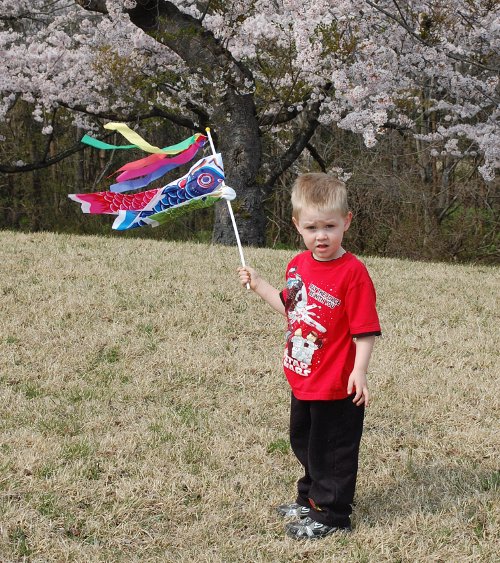
Cute. Super cute.

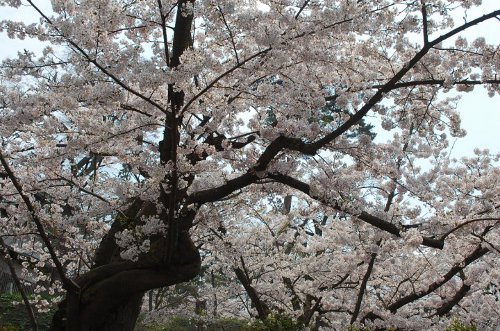
They cherries bloom here in profusion and, for some reason, no one is ever here. (What a contrast to our day trip to the castle! Sheesh!)

Such fun!

Once more, just because they’re so stinking cute.

Could this BE more picturesque?

So, we went and ran among the cherry blossoms with our carp kites, and in true hanami fashion we brought a treat to eat while we enjoyed the beauty.
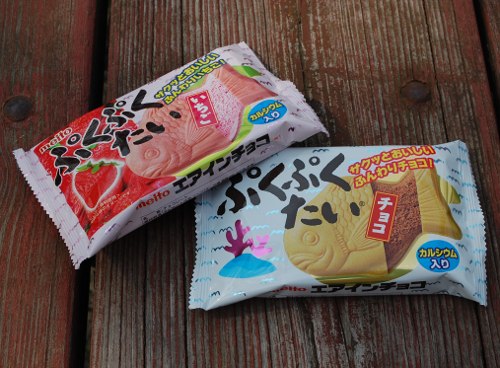
Man. I wish I had some REAL taiyaki right now!

Mmmm, fish candy. Seriously, though, this is a candy homage to a real treat – Taiyaki! Taiyaki are basically fish-shaped waffles filled with custard, or cream, or chocolate, or red bean paste. (I’m not so keen on the red bean paste, but I’ll scarf down the others any day of the week!) If I may geek out on Japanese grammar for a moment, Taiyaki is a compound word comprised of two smaller segments: ‘tai,’ or a specific kind of fish, and ‘yaki,’ a frying method known from other such favorites such as yakisoba (fried noodles) and yakitori (fried chicken). ‘Yaki’ in the name of your food is generally a good sign. If you’re up on your hiragana, you’ll notice that these candy fish are labeled ‘pukupuku tai,’ or,  ‘bubbling fish,’ since the filling is commonly known as ‘choco with air,’ aka aerated chocolate. I love this, too. But back to the cherry blossoms!

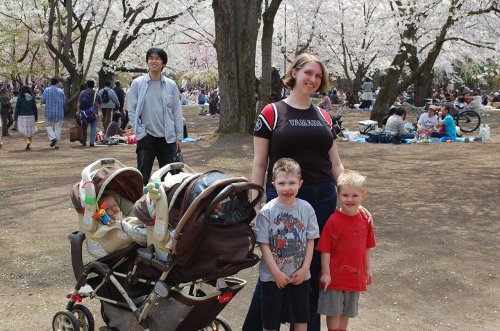
Look at my guys...

Max looked at me strangely when I let him eat with Charlie over on the other side of the hill. “But Mommy, we’re so far away!” he shouted. He must have been remembering how I freaked out at him in Hirosaki when he tried to walk more than two steps away from me. I guess we haven’t covered ‘different rules for different situations’ well enough.

When we got home, we hung up our own koinobori on a pole on our porch.
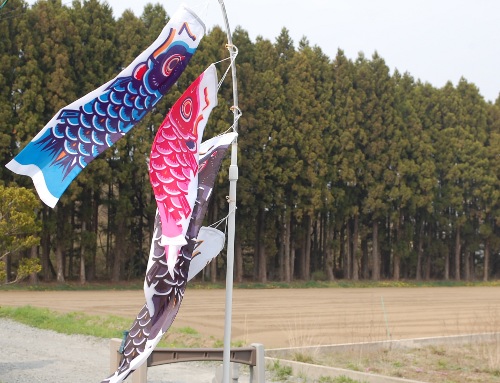
They look like they are having a lot of fun swimming.

The wind did not cooperate well with my attempt to photograph them. Oh, well.  I got four: the top one is for Max, the second for Charlie, and the two black fish on the bottom are for Tommy and Teddy. I’m pretty sure that as far as traditional Japanese practice goes, I’ve hung them wrong…but I like them. And someday, maybe all my little carp will be dragons.

Of Castles and Cherry Blossoms

If you’re even distantly familiar with Japanese culture you will recognize that right now – the springtime – is when a massive event sweeps the nation, from the south to the north. The cherry blossoms are blooming.

Sakura, sakura!

While the blooming of the cherry blossoms is not technically a holiday, it creates a festive spirit and it is customary to take whatever time is possible for the hanami – the flower-viewing. Here in the north, the blossoming coincides with Golden Week – a week-long celebration that contains multiple holidays – and so everyone is off of work and out of school, allowing them to take their picnics out to the parks and gardens to enjoy the flowers.

Since this is our last spring here, we decided to join the throngs headed to the most popular cherry-viewing site in the region: Hirosaki Castle.

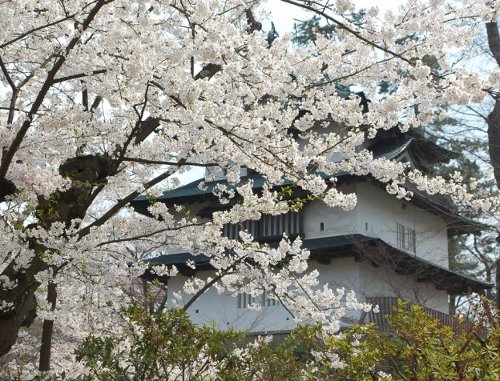
Nice castle.

The drive was harrowing. The traffic was deadlocked. The crowds were massive. The parking was next-to-nonexistent. But the cherries were beautiful.

Look at those blooms!

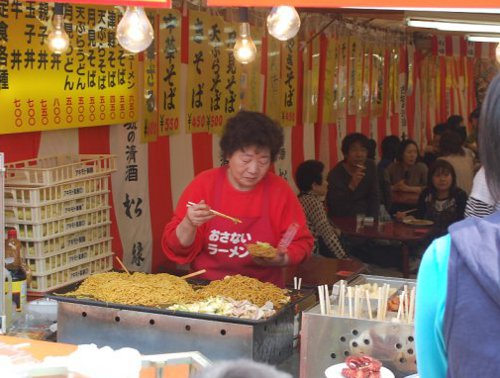
There were dozens of stands situated around the castle grounds to cater to the people who came in their thousands to see the cherry trees. (Including one that was selling only fresh bananas, which I thought was odd at a fair-type assemblage.) We saw familiar foods,

Mmm, soba!

Some real doozies of creative festival food…

Mmm, octopus...balls?

And some real favorites.

Ringo aisu wa oishi desu!

I’ve said it before and I’ll say it again: ringo aisu (apple ice) kicks butt!

Matsuri wa tanoshii desu yo!

All in all it was grueling, fun, beautiful, memorable, culturally interesting – and tasty. Not bad for a day’s driving.


Introducing Young Kids to the Piano

What nice keys you have!

Why, hello there . . . I’m a piano.

A month or so ago, our piano finally made it out of storage – aka my bedroom closet – and back to the place in the living room usurped by our Christmas tree. (I would like to reassure all the horrified members of the readership that our Christmas tree has long since been packed away. Two months ago, at least!)

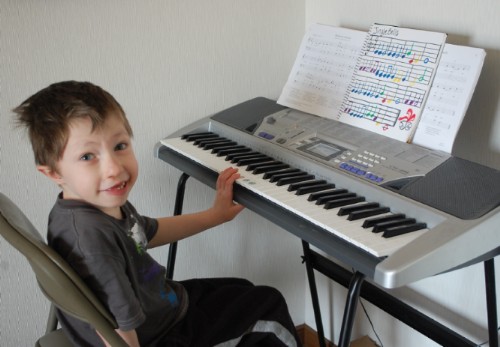
Max and Charlie were so excited to have it back again! They played on it every day, all day. Any time they had a moment of down time one or both of them were over in the corner, playing a song I mentally labeled ‘Potato Masher.’ Since, in my head, my sons will one day be skilled pianists, I was pleased by their dedication. However, ‘Potato Masher’ began to wear on me. I decided that Max, at least, was old enough to learn a simple tune to play between mashups. (See what I did there? Hahaha.)

Max thought differently. He was more than willing to learn, but it was pretty clear that he couldn’t see any distinguishing features among the keys besides ‘black’ and ‘white.’ So, before both of us got frustrated, I devised an alternate approach.

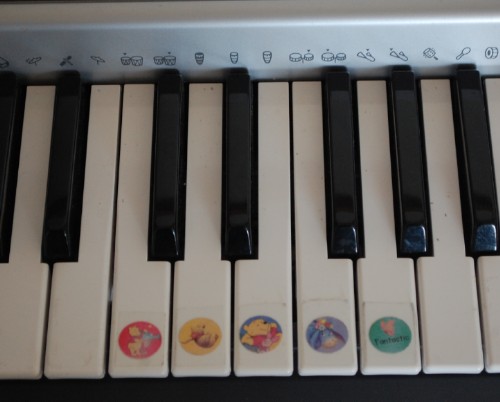
Red, yellow, blue, purple, green!

Pooh can do it!

I cut a small piece of clear contact paper and applied it to the keys. Over that, I placed brightly colored stickers. The contact paper is theoretically to protect the keys from sticker residue. (My piano has plastic keys. I won’t vouch for what contact paper will do to antique ivories. Why is your kid learning to play on an expensive antique, anyway?) Each note gets a different color. We started with three notes – now we have five – and I may be adding more soon.

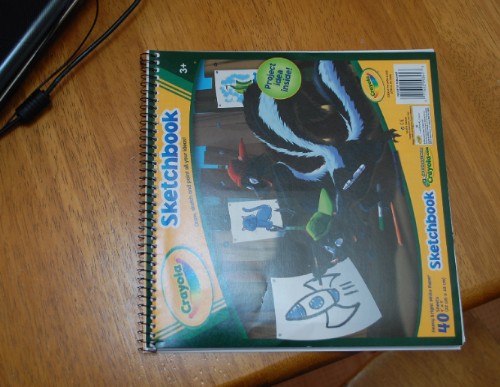
Next, I took a spiral-bound sketchbook and turned it sideways . . .

Yup. A notebook!

This one was $1.49.

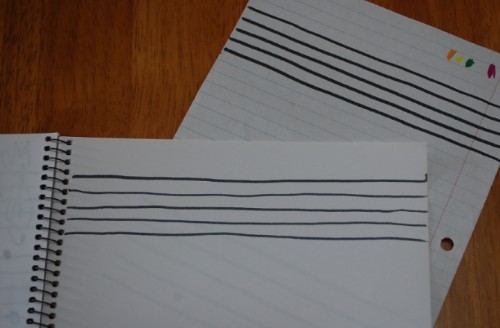
. . . used a sheet of notebook paper as a guide . . .

Curse my wobbly tracing.

Just imagine how wiggly the lines would be if I didn’t use a guide!

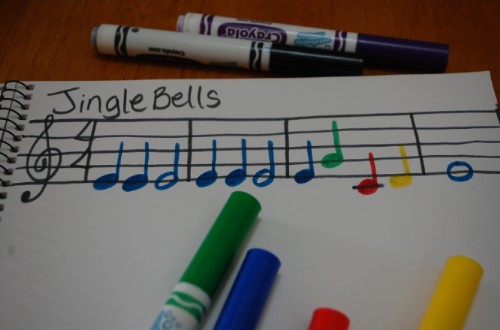
. . . and wrote out some simple songs, matching the notes and colors…

It's never too late for Jingle Bells!

Look. It’s never the wrong season for Jingle Bells.

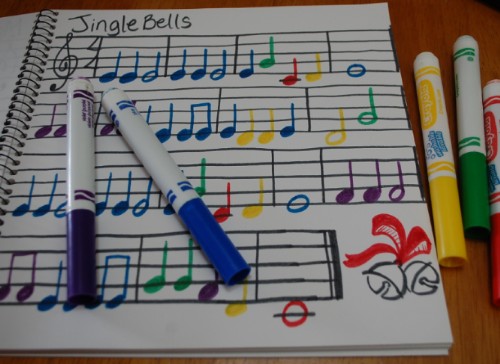
. . . and added a picture so that the boys know which song they’re playing.

Jingle bells, jingle bells...

And it looks pretty, too!

First we had experimented with songs written just as a series of dots, then I wrote some with the note values but no staff, but I think that having the notes on a staff will help the kids get used to reading music without realizing that they’re doing it. Plus, the same music can still be used without the stickers because it’s actually musical notation.

Max practices his songs devotedly and can play them quite well – and even Charlie, at three years old, can play ‘Mary had a Little Lamb’ beautifully. Let me tell you, it’s a refreshing change from ‘Potato Masher.’

Good job, sweetie!

Leave me a comment?